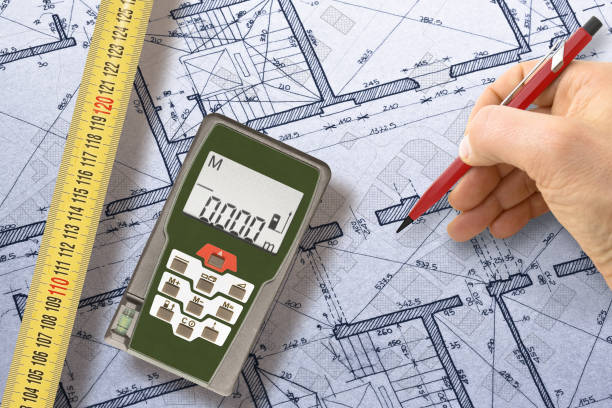
The Handheld Laser Distance Meter Market history reflects a remarkable transformation from traditional measuring techniques to modern, smart tools powered by advanced laser technology. These devices, once viewed as specialized tools for high-end construction or surveying, have now evolved into essential gadgets across various industries. This shift is rooted in the increasing demand for accurate, efficient, and user-friendly measurement solutions, which has redefined how professionals and consumers alike approach distance and spatial calculations.
The Roots: From Manual to Mechanical
The journey of distance measurement began with rudimentary tools such as measuring tapes, chains, and rulers. While these tools served basic needs, they lacked the accuracy and efficiency required for large-scale or precise tasks. The mechanical measuring wheels and analog distance indicators that came next marked an improvement but were still dependent on physical interaction and prone to human error.
The 20th century witnessed the introduction of ultrasonic distance meters, which operated by sending sound waves and calculating the time taken for the echo to return. Although groundbreaking at the time, ultrasonic meters struggled with accuracy due to environmental factors like temperature, surface texture, and angle of measurement.
Breakthrough with Laser Technology
The late 1980s and early 1990s marked a turning point with the adoption of laser technology for distance measurement. This innovation brought a dramatic increase in accuracy, speed, and usability. Early laser distance meters were bulky and costly, primarily used in industrial and military applications. However, the potential was clear: by using laser beams to calculate the time it took for light to bounce back from a target, highly precise measurements could be obtained without contact.
The miniaturization of laser components and advances in digital processing during the early 2000s made it possible to develop portable, handheld laser meters. This opened the market to broader applications in construction, real estate, architecture, engineering, and even interior design.
Market Expansion and Technological Advancements
The history of the handheld laser distance meter market cannot be told without acknowledging the wave of innovation that followed. Devices became lighter, more durable, and significantly more functional. Manufacturers integrated features such as Bluetooth connectivity, memory storage, real-time data transfer, and app compatibility. These enhancements made handheld laser meters invaluable in digital workflows, allowing seamless data integration with design and planning software.
In addition, the incorporation of multi-mode functions—such as area calculation, volume measurement, indirect Pythagorean measurements, and inclinometer-based angle measurement—expanded their utility far beyond simple distance measuring.
Rise of Consumer Use and DIY Market
As the prices of laser meters dropped and user interfaces became more intuitive, a new segment emerged within the handheld laser distance meter market: the DIY and home improvement users. Once tools reserved for professionals, these devices became household tools for enthusiasts and everyday users aiming to hang shelves, plan home renovations, or measure interior spaces accurately.
Retailers and online platforms further accelerated this trend by offering a wide range of affordable and feature-rich models. Marketing efforts highlighted ease of use, portability, and reliability, positioning these meters as tools anyone could use, not just construction experts.
Digital Transformation and Smart Integration
In recent years, the market history has been marked by integration with smart ecosystems. Handheld laser distance meters are increasingly being designed to work with smartphones, tablets, and cloud systems. This integration supports instant sharing, remote collaboration, and real-time project management, which is particularly valuable for construction managers, architects, and surveyors working on complex, multi-location projects.
The rise of IoT (Internet of Things) also plays a pivotal role in the market’s progression. Laser distance meters are now being incorporated into broader systems that include thermal imaging, GPS, 3D scanning, and augmented reality. These multifunctional tools are reshaping how space is measured and visualized, especially in smart building and infrastructure development.
Global Market Dynamics and Regional Evolution
The global expansion of the handheld laser distance meter market has mirrored technological growth and infrastructure development trends across regions. Developed markets in North America and Europe have consistently driven early adoption due to high standards in construction quality and safety regulations. Meanwhile, Asia-Pacific has emerged as a growth leader in recent years, fueled by rapid urbanization, smart city initiatives, and increasing demand for cost-effective, modern construction solutions.
Local manufacturers in countries like China and India are producing affordable meters with impressive specifications, thus intensifying competition and making the technology more accessible across all economic tiers.
Challenges and Innovations Ahead
Despite the impressive trajectory, the market continues to face challenges such as the saturation of low-end products, counterfeit devices, and the need for continual innovation to stay competitive. Users now expect more than just precision—they want intelligent interfaces, integration with Building Information Modeling (BIM) systems, and environmental adaptability.
To stay ahead, manufacturers are exploring features like voice command operation, gesture control, solar-powered units, and even AI-enhanced measurement analysis. These innovations aim to create a seamless blend between hardware functionality and software intelligence.
Conclusion: A Legacy of Precision, A Future of Possibilities
The Handheld Laser Distance Meter Market history is a story of evolution from manual to digital, from isolated tools to interconnected smart systems. What began as a niche solution for professionals is now a mainstream device accessible to all. As technology continues to evolve, these devices will likely become even more powerful, compact, and intelligent, further shaping the way we interact with physical spaces in construction, design, and beyond