Co-Packaged Optics Market Innovations Redefining Data Center Connectivity and High-Speed Network Efficiency

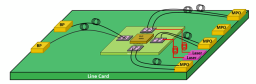
The co-packaged optics market is undergoing a wave of innovation that is revolutionizing how data centers and high-performance networks manage bandwidth and power efficiency. By placing optical components directly next to switching ASICs on a single substrate, co-packaged optics (CPO) eliminate many of the limitations of traditional pluggable optics. This shift is enabling ultra-high-speed communication while lowering energy consumption, making it a vital solution for next-generation data demands.
With the exponential growth of AI workloads, cloud services, and edge computing, the need for faster, more scalable, and energy-efficient network infrastructure is greater than ever. Innovations in CPO are rapidly reshaping the market landscape and offering unprecedented opportunities for scalability, integration, and performance optimization.
Silicon Photonics Integration
One of the most critical innovations driving CPO is the advancement in silicon photonics. Unlike conventional optics, silicon photonics allows photonic components—such as modulators, multiplexers, and detectors—to be manufactured using standard semiconductor fabrication processes.
This integration brings several benefits: it reduces the size and cost of optical components, improves reliability, and allows for mass production. Silicon photonics also enables tight co-location with CMOS electronics, a fundamental requirement for successful co-packaging. Major players are now investing in monolithic integration to streamline manufacturing and optimize signal transmission, propelling the technology toward broader adoption.
Advanced Packaging Technologies
Innovative packaging solutions are at the heart of co-packaged optics. Traditional transceiver packaging methods are not suitable for the dense, thermally sensitive nature of CPO systems. To overcome this, new techniques such as 2.5D and 3D packaging, chiplet architectures, and embedded optical interfaces are being developed.
These approaches allow multiple dies—optical, electrical, and control—to be housed in a compact and efficient form factor. The result is a high-bandwidth, low-latency optical module with superior signal integrity. This innovation significantly reduces the power budget and improves thermal management, addressing one of the biggest barriers to CPO deployment.
Thermal Management Solutions
As optical engines are placed close to heat-generating ASICs, effective thermal management becomes a top priority. Innovations in cooling solutions have emerged as critical enablers for CPO technology. These include integrated heatsinks, microfluidic cooling, vapor chambers, and even liquid cooling systems embedded in the switch design.
These technologies help maintain operational temperatures within safe limits without compromising performance or form factor. Smart thermal monitoring systems are also being integrated to dynamically regulate heat across the CPO module, ensuring long-term reliability and power efficiency.
High-Speed Electrical-Optical Interfaces
Another area of significant innovation is in the development of high-speed interfaces that connect electrical and optical domains. Traditional electrical links lose signal integrity at high speeds over longer distances. In contrast, co-packaged optics use ultra-short electrical paths combined with high-performance optical interfaces to achieve seamless data transmission.
Innovations such as PAM4 (Pulse Amplitude Modulation), coherent optics, and low-loss interconnect materials are enabling data rates of 800G and 1.6T while maintaining signal clarity. These advances are essential for meeting the speed requirements of modern data centers and AI applications.
AI-Driven Design and Testing
Artificial intelligence is also playing a role in accelerating co-packaged optics innovation. AI algorithms are now used in thermal simulation, signal integrity modeling, and automated testing. These tools help engineers identify optimal layouts, predict performance bottlenecks, and streamline validation processes.
Machine learning is being applied to test data for anomaly detection, predictive maintenance, and process optimization. As these AI-driven methods mature, they will significantly reduce development cycles and enhance the reliability of CPO modules.
Standardization and Interoperability
While technical innovation is essential, standardized approaches are equally crucial for market scalability. Industry organizations like the Optical Internetworking Forum (OIF), IEEE, and COBO are driving initiatives to establish common form factors, electrical and optical interfaces, and performance metrics.
Recent innovations include the development of universal connector standards and management interfaces that allow modules from different vendors to interoperate. This standardization fosters competition, reduces deployment risk, and accelerates ecosystem growth—key ingredients for innovation diffusion across the market.
Integration with Next-Gen Network Architectures
Co-packaged optics are being designed to integrate seamlessly with evolving data center and network architectures. With trends like disaggregated infrastructure, software-defined networking (SDN), and edge computing gaining momentum, innovations in CPO are aligning with these architectural shifts.
This includes modular optical engines that can be upgraded independently of switching ASICs, and flexible optical fabrics that support dynamic reconfiguration of data paths. These innovations ensure that co-packaged optics are not just a component-level improvement, but a cornerstone of future-proof network design.
Conclusion
The co-packaged optics market is being redefined by a surge of innovations across silicon photonics, packaging, cooling, and signal processing. These advancements are addressing the critical challenges of power efficiency, bandwidth scalability, and integration complexity, unlocking new possibilities for data centers and communication networks. As the pace of technological change accelerates, co-packaged optics are poised to become a foundational element of high-speed, energy-efficient networking infrastructure. The innovations highlighted here are not just enhancing performance—they are shaping the future of global connectivity.